

Upwork Skill Graveyard 2026: Which Skills Are Losing Ground
The easy story about Upwork in 2026 is "legacy skills are dying, modern skills are rising." We went looking for that story in 3.2 million-plus job postings. We didn't find it. What we found instead is more interesting: almost nothing is gaining ground right now, and the handful of skills you'd expect to be winning are losing share just as fast as the ones everyone already assumes are dead.
This is a companion piece to our demand-side look at whether Upwork is worth it in 2026, which found new job postings down 19.1% from H1 2025 to H1 2026. That decline is the context for everything below. When the whole pond shrinks, the question worth asking isn't "is this skill growing or shrinking in raw count," it's "is this skill shrinking faster or slower than the market itself."
The Method
We compared two six-month windows, H1 2025 (January to June) and H1 2026 (January to June), across every job in our dataset tagged with a given skill in Upwork's own ontologySkills taxonomy. Job volume fell from 1,185,547 in H1 2025 to 959,063 in H1 2026, a decline of 19.1%. For each candidate skill we counted exact-label matches in both windows, then compared each skill's share of all jobs in each window, not just the raw count. Raw counts fall for almost everything when the total pool shrinks by a fifth. Share is the number that tells you whether a skill is losing relevance, or just riding the same tide as everything else.
What We Expected vs What We Found
The hypothesis going in was simple: WordPress, PHP, jQuery and the rest of the "legacy web" stack would be losing share to React, TypeScript, Swift and Flutter. That is the story told in a lot of 2026 freelance content, including our own Vibe Coding Tools piece. It's half right and half wrong.
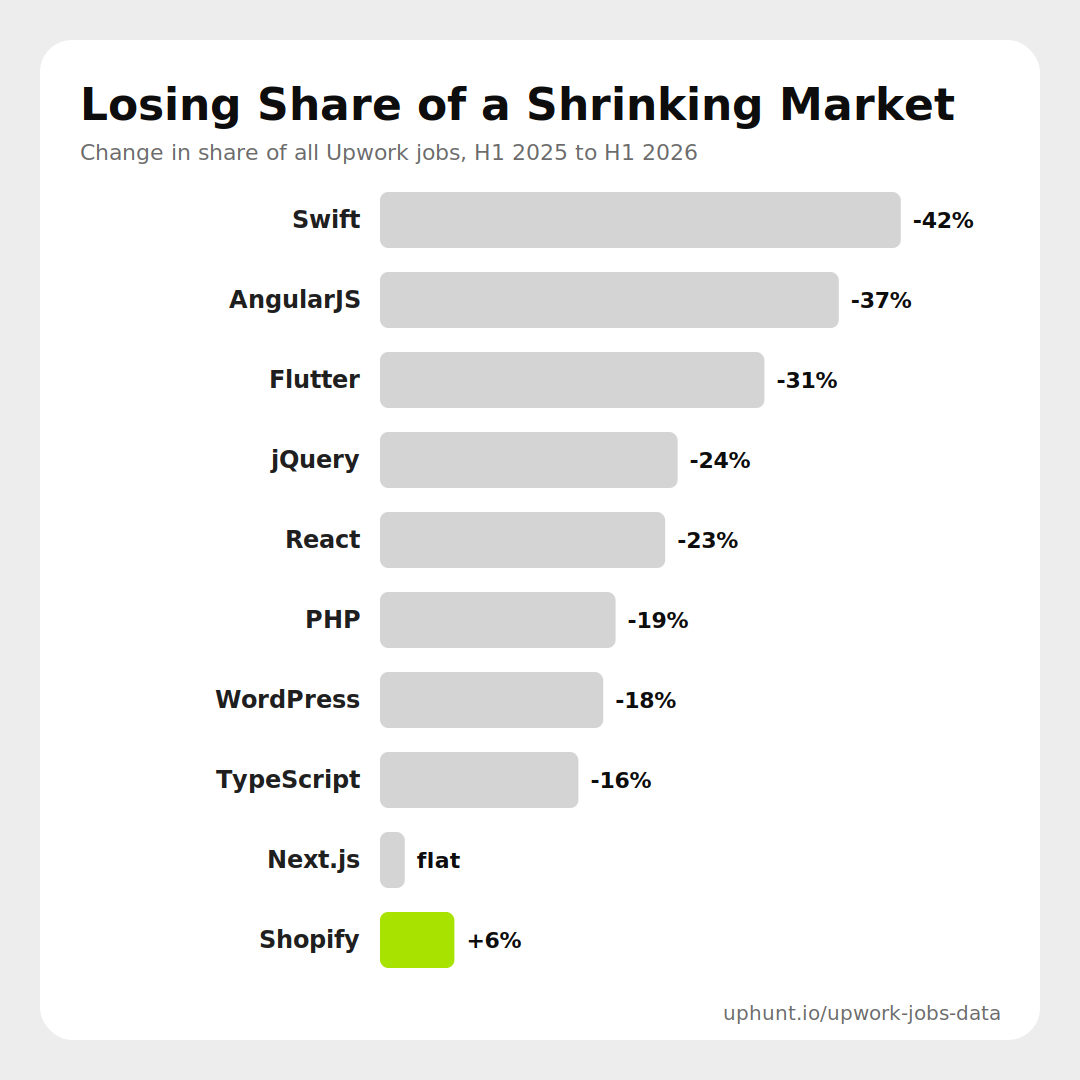
Here is the share change for ten well-tracked skills, ranked by how much ground they lost:
| Skill | H1 2025 jobs | H1 2026 jobs | Share change |
|---|---|---|---|
| Swift | 4,200 | 1,959 | -42% |
| AngularJS | 1,980 | 1,014 | -37% |
| Flutter | 7,093 | 3,974 | -31% |
| jQuery | 3,211 | 1,962 | -24% |
| React | 26,643 | 16,620 | -23% |
| PHP | 48,371 | 31,628 | -19% |
| WordPress | 88,795 | 59,097 | -18% |
| TypeScript | 8,168 | 5,551 | -16% |
| Next.js | 7,122 | 5,740 | flat |
| Shopify | 41,524 | 35,443 | +6% |
Swift lost more relative share than WordPress. React lost more than PHP. AngularJS, a framework most engineers consider legacy already, and Flutter, a framework most people assume is on the way up, sit right next to each other in the decline column. The "modern stack replacing legacy stack" story doesn't survive contact with the data. What's actually happening is closer to a broad-based contraction, with almost every individual skill losing ground to the market average, not to a specific rising competitor.
The Two Exceptions
Two skills bucked the trend, and neither is the one the "AI is eating legacy code" narrative would predict.
Next.js held essentially flat, going from 0.601% of all jobs to 0.599%, a rounding error's worth of change. In a market where React itself lost 23% of its relative share, the framework built on top of React barely moved. That's a meaningful signal on its own: clients hiring for React work increasingly want it wrapped in Next.js specifically, not the bare library.
Shopify is the only skill in this set that actually gained share, climbing from 3.503% to 3.696% of all jobs, a relative gain of about 6%. This lines up with what our data has shown before: Shopify has been a consistently resilient category through several rounds of "is e-commerce dev dying" speculation. When almost every other named skill is losing ground, gaining any share at all is a real result, not noise.
A caveat on smaller categories: Joomla, Drupal, Objective-C and Perl all point the same direction as the larger skills above (down, some sharply), but their raw counts are thin enough (Perl fell from 105 to 34 jobs) that we're not putting them in the headline chart. Directionally consistent, statistically light. Worth watching, not worth betting on.
Why This Matters More Than the Legacy-vs-Modern Story
If you're picking a niche based on "modern beats legacy," this data says that framing will mislead you. The real question for 2026 isn't which stack you know, it's whether you're competing in a category that's shrinking in line with the market (most of them) or one of the rare categories holding its ground. Shopify freelancers are in a better relative position this year than React freelancers, and that has nothing to do with which technology is more sophisticated.
It also reinforces something we found in the demand-side study: budgets held roughly flat even as volume fell. A smaller, more competitive pool means the freelancers who show up fast and match well are capturing a larger slice of a shrinking pie. That is exactly the gap UpHunt is built to close: real-time monitoring of every new Upwork post, AI scoring against your actual skills, and for Auto-Apply users, submission from a dedicated Upwork business-developer account inside your own Agency Plus, so the first-mover advantage in a tightening market goes to you instead of whoever happens to be refreshing the feed.
What To Do With This
If your core skill is on the decline list, that doesn't mean stop bidding, it means expect more competition for the same slice and prioritize speed and targeting over volume. If you're a Shopify or Next.js freelancer, the data says you're in one of the few categories not losing relative ground, which is worth leaning into rather than diversifying away from out of caution. Either way, the lesson isn't "learn a new stack," its "know exactly where your stack sits in a shrinking market before you decide how hard to compete in it."
UpHunt's Basic plan starts at $27/month for unlimited AI-scored job feeds across every skill category, real-time notifications the moment a matching job posts, and a 7-day free trial to see where your own skills actually rank in today's market before you commit.
Methodology Note
All figures come from UpHunt's live dataset of public Upwork job postings, filtered by exploredAt (when we scraped the job) and matched against Upwork's own ontologySkills.prefLabel taxonomy for exact skill labels. H1 2025 covers January through June 2025; H1 2026 covers January through June 2026. Job volume totals are drawn from the same monthly aggregation used in our Is Upwork Worth It 2026 study. Share change is calculated as the relative percent change in each skill's share of total job volume between the two windows, not the change in raw job count.