

Is Upwork Worth It in 2026? What 3.25 Million Job Postings Actually Show
Search "is Upwork worth it 2026" and you'll find a stack of personal breakdowns: one freelancer's six months, one agency's take-home math, one bad-client story generalized into a verdict. None of them run on more than a handful of contracts. We can't tell you what your take-home will be either, we don't have proposal or hire data, but we do have something nobody else cited in this search: 18 months of every public job Upwork posted, queried directly.
Two separate questions get lost inside "is Upwork worth it": is there less work showing up, and is the work that does show up paying less. The dataset answers both, and the answers point in different directions.
The headline: job postings are down 19% year over year
We pulled every job UpHunt's scraper logged between January 2025 and June 2026, 3,257,542 postings across 18 full months, and grouped them by month. The trend is not subtle.
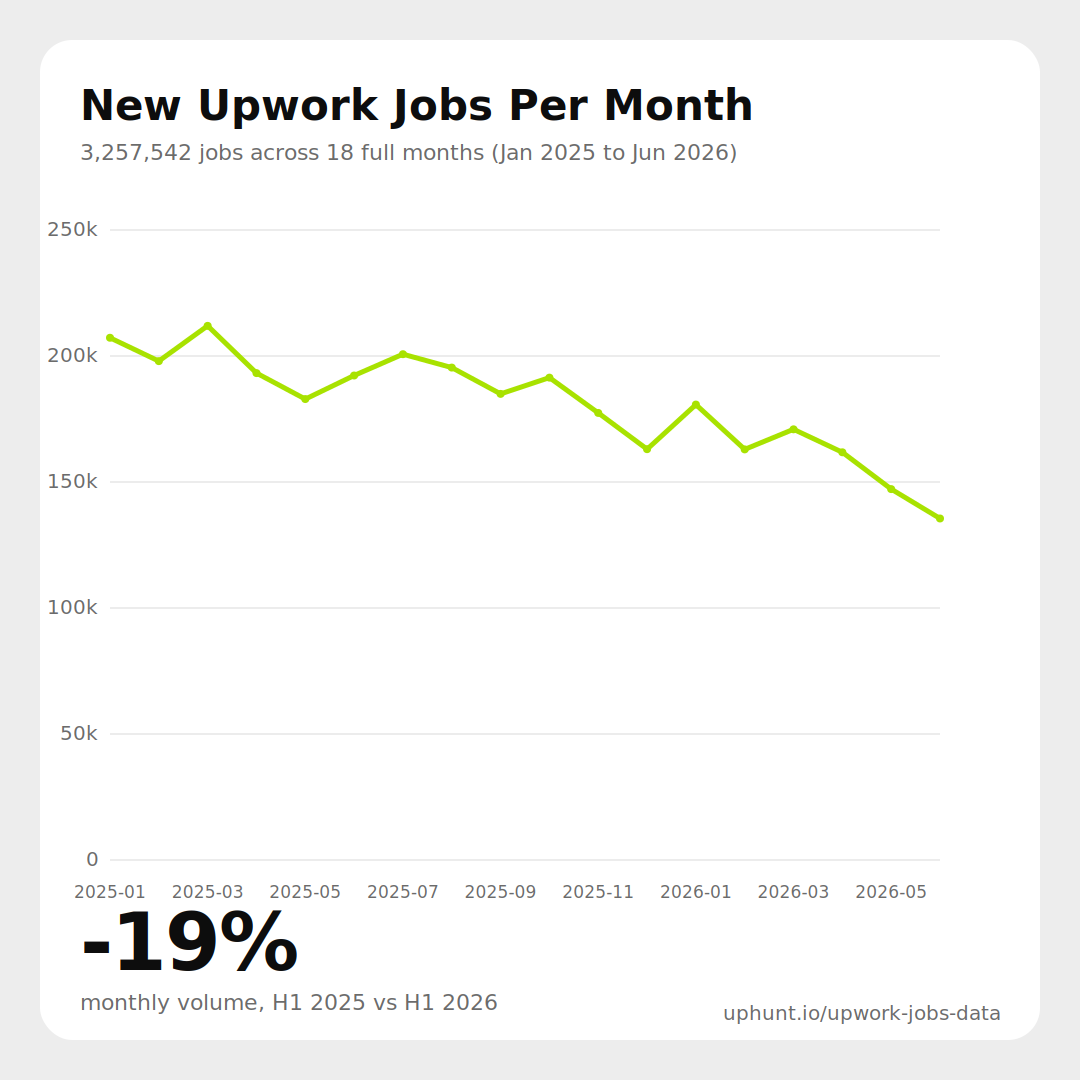
The first half of 2025 averaged 197,591 new postings a month. The first half of 2026 averaged 159,844. That's a 19.1% drop, and it isn't one bad month dragging the average down, the line trends down almost the whole way, from a peak of 211,968 in March 2025 to 135,518 in June 2026.
This matches what we found when we tracked where legacy-stack Upwork work went: categories like WordPress development are shedding jobs faster than newer tool categories can absorb them. This new number is the platform-wide version of that same story. Fewer jobs are being posted, full stop, not just in the categories AI tooling touches most directly.
We cant fully separate "clients are posting less" from "some categories consolidated into fewer, larger postings" from our own data alone. What we can say confidently: the number of distinct opportunities landing on the feed each month is meaningfully smaller than it was 18 months ago.
The part that surprised us: budgets did not fall with volume
If job volume is down almost a fifth, the obvious next guess is that rates cratered too, more freelancers chasing fewer jobs, clients holding leverage, budgets racing to the bottom. That is not what the numbers show.
Comparing the same two windows, first half of 2025 versus first half of 2026:
| Metric | H1 2025 | H1 2026 | Change |
|---|---|---|---|
| Fixed-price average | $455 | $470 | +3.3% |
| Fixed-price median | $111 | $120 | +7.7% |
| Hourly average | $26.36/hr | $26.46/hr | +0.4% |
| Hourly median | $22.50/hr | $21.50/hr | -4.4% |
Fixed-price budgets rose on both average and median. Hourly budgets held almost flat, with the median dipping slightly while the average ticked up, which usually means the mix shifted a little toward higher-budget outliers rather than every hourly job getting cheaper across the board. Nothing here shows a rate collapse. If anything, the fixed-price side got modestly better for the jobs that are still being posted.
Put the two findings together and the honest read is: Upwork in 2026 is a smaller pond, not a worse-paying one. There are fewer opportunities to compete for, but the ones that exist are not paying meaningfully less than they were 18 months ago, and fixed-price work is paying somewhat more.
What this doesn't tell you
We want to be direct about the limits of this dataset before anyone overreads it. We track public job postings, not proposals, not hires, not freelancer earnings, and not win rates. We cannot tell you your odds of landing a specific job, how much take-home pay to expect, or whether a shrinking feed means more or less competition per job, since we don't have proposal counts either. Anyone claiming a precise "keep X% of every dollar" figure from public posting data alone is extrapolating past what that data can show, which is exactly the gap in most of the personal-anecdote posts on this topic.
What the postings data can tell you, reliably: how many opportunities are appearing, and what they're budgeted at. On both counts, the direction is now backed by a full-platform count instead of one person's spreadsheet.
What this means if you're deciding whether to stay
A shrinking feed with stable-to-rising per-job budgets points toward a specific strategy: fewer shots, so each one needs to count. That means applying inside the window when a client is actually reading, not after the feed has moved on, our best time to apply analysis breaks down exactly when that window falls. It means being pickier about which of the shrinking pool of jobs is worth a Connect at all, which is most of what our Connects pricing guide and red flags checklist are for. And if you're wondering whether specific categories are part of the decline or the (smaller) growth side, where the work actually went breaks that down tool by tool.
Fewer jobs does not have to mean a worse outcome if you're only competing seriously for the ones worth competing for. That's a targeting problem, and it's the one UpHunt's job feed and AI scoring are built to solve, we track the shrinking feed in real time so you see a matching job the moment it posts instead of finding it after the window has already closed.
Methodology
This analysis covers 3,257,542 Upwork job postings scraped between January 2025 and June 2026 (18 full months; December 2024 and July 2026 are excluded as partial months). Job volume is grouped by the month UpHunt's scraper recorded the posting. Fixed-price figures exclude a small number of exact-$100 placeholder listings and outliers above $10,000, matching the same cleaning method used across our other data posts. Hourly figures use the midpoint of each job's posted min/max hourly range. All figures come from UpHunt's own dataset of public Upwork job postings and are not affiliated with or endorsed by Upwork. See the full dataset →