

Is Upwork Getting Harder for Beginners in 2026?
Every beginner who lands on Upwork this year asks the same question, usually after a dozen proposals go nowhere: is it me, or is this platform just harder now? We went looking for an answer in the data instead of the anecdotes, and the honest version is uncomfortable. Yes, it is getting harder for beginners, and it is getting harder for beginners specifically, faster than for anyone else.
We looked at every Upwork job posting in our dataset across two matched six-month windows, H1 2025 and H1 2026, and split them by the experience level the client asked for. The headline: entry-level postings are drying up almost twice as fast as the market around them.
Beginner Jobs Fell 29.3%, the Market Fell 19.1%
Overall job volume on Upwork is down. We covered the demand-side collapse in our look at whether Upwork is still worth it in 2026, where total new postings fell from 1,185,547 in H1 2025 to 959,063 in H1 2026, a 19.1% drop. That is the tide every experience level is swimming against.
But the tide is not even. When we split postings by the experience level the client selected on the job (Upwork tags every job Entry, Intermediate, or Expert), the entry-level rung is falling out from under new freelancers:
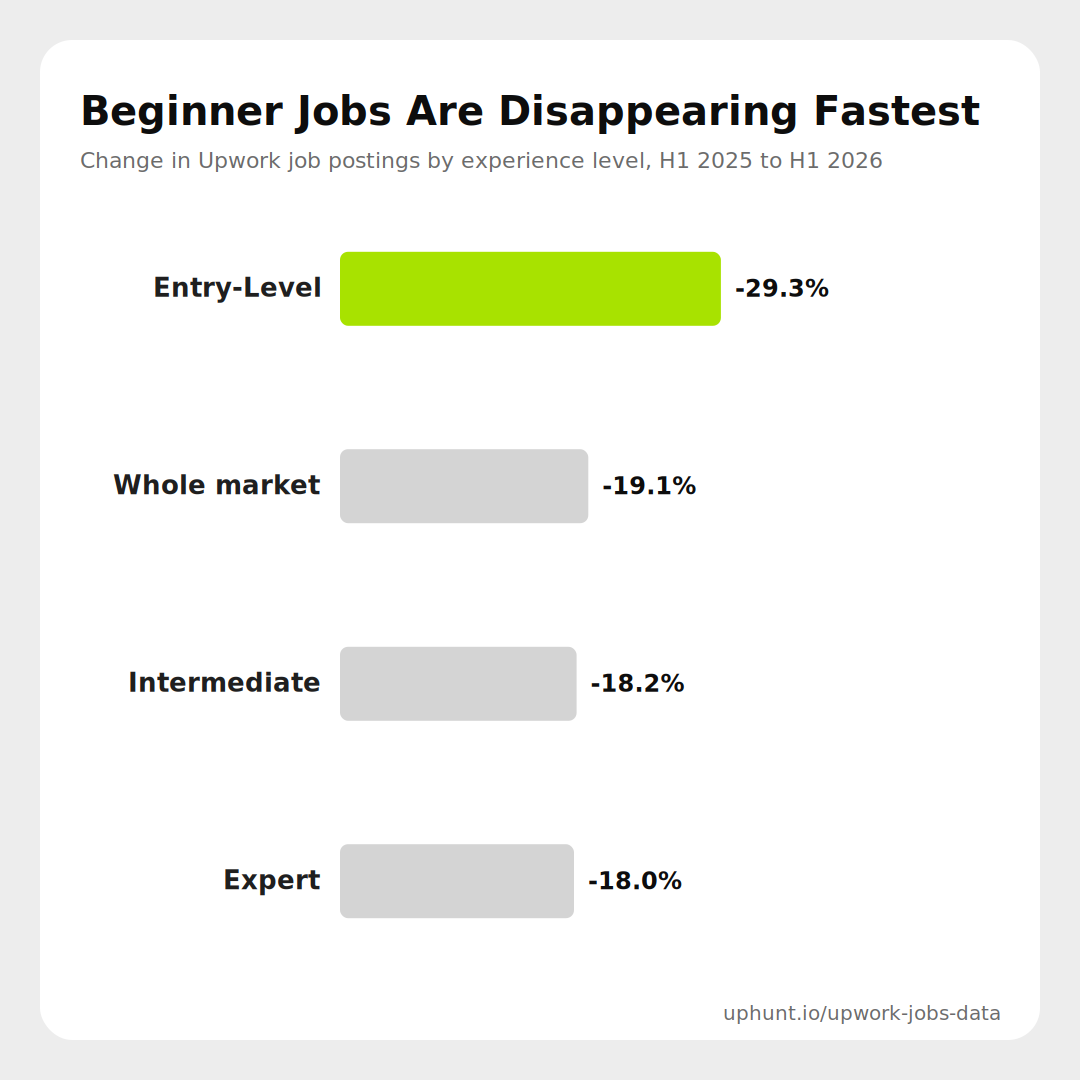
| Experience level | H1 2025 jobs | H1 2026 jobs | Change |
|---|---|---|---|
| Entry-Level | 106,485 | 75,268 | -29.3% |
| Intermediate | 776,179 | 634,951 | -18.2% |
| Expert | 302,520 | 247,949 | -18.0% |
| Whole market | 1,185,547 | 959,063 | -19.1% |
Intermediate and expert postings both fell around 18%, essentially tracking the market. Entry-level postings fell 29.3%, more than ten points steeper. The rung you are supposed to start on is the one shrinking fastest.
Share of the Market, Not Just Raw Count
Raw counts fall for almost everything when the whole pond shrinks by a fifth, so the number that actually isolates a beginner's trajectory is share of all jobs, not the raw total. We ran that too, and it tells the same story from a different angle.
Entry-level jobs were 8.98% of all postings in H1 2025. By H1 2026 they were 7.86%. That is a 12.5% relative drop in the slice of Upwork that is even open to beginners. Over the same window, expert jobs edged up from 25.53% to 25.88% of the market, and intermediate from 65.49% to 66.27%. Experts and mid-level freelancers held their share of a shrinking market. Beginners lost theirs.
This lines up with what we found in the Upwork skill graveyard: the simple commodity work that used to be a beginner's on-ramp is exactly the work getting absorbed by AI and by clients doing it themselves. When the easy tasks evaporate, the entry-level tier evaporates with them.
What This Actually Means If You Are Starting Out
The data is discouraging, but it is not a stop sign. It is a strategy note. A few things follow directly from the numbers.
There are fewer beginner jobs, so the ones that exist fill faster. With entry-level supply down nearly a third, the remaining postings draw the same crowd of new freelancers into a smaller pool. The jobs that used to sit open for a day now close in hours. Speed stopped being a nice-to-have and became the whole game. This is why we built instant job alerts: if you are seeing an entry-level job on the Upwork feed an hour after it posted, you are already at the back of the line.
Do not only fish in the entry-level pond. Intermediate work held its share and still makes up two thirds of all postings. If your skills are even slightly past absolute beginner, tagging yourself and applying to intermediate jobs is not overreaching, it is where the volume is. Plenty of intermediate clients care more about a sharp, specific proposal than a long work history.
Every proposal has to earn its Connects. When the beginner pool is this tight, spraying generic proposals at fifty jobs is the fastest way to burn out and go broke on Connects. The freelancers who win now read the job, match it, and apply early. Our guide on why you might not be getting jobs breaks down the mechanics, and our timing analysis shows how much being early actually moves reply rates.
The Method
We compared two six-month windows, H1 2025 (January to June) and H1 2026 (January to June), across every Upwork job in our dataset. Each job carries the experience level the client requested in Upwork's own job data (contractorTier), populated on 99.97% of postings, so no modeling or inference was needed, just a direct count of Entry, Intermediate, and Expert postings in each window. We then compared both the raw count change and each tier's share of all jobs. The share comparison is what separates a real decline from the market-wide contraction, and its the reason we lead with it.
The Bottom Line
Upwork is not rigged against beginners, but the math has quietly turned against them. Entry-level postings fell 29.3% year over year while everyone else fell about 18%, and beginners lost a real slice of an already smaller market. Starting out in 2026 means fewer shots, faster-closing jobs, and no room for lazy proposals.
That is exactly the problem UpHunt was built to solve for people who do not have a big work history to lean on yet: real-time alerts the moment a matching job posts, plain-language AI scoring so you spend Connects only on jobs worth your time, and, when you are ready to scale, managed applying so you are first in the stack instead of last. You dont need to out-experience the experts. You need to out-speed the other beginners.