

Upwork Hourly vs Fixed-Price Jobs: Which Should You Bid On? (Hire Rates From 4,583 Tracked Postings)
Most advice on Upwork hourly vs fixed-price jobs is about the contract: payment protection, milestones, which one is safer. None of it answers the question that decides whether your Connects come back: which type of job actually ends in a hire?
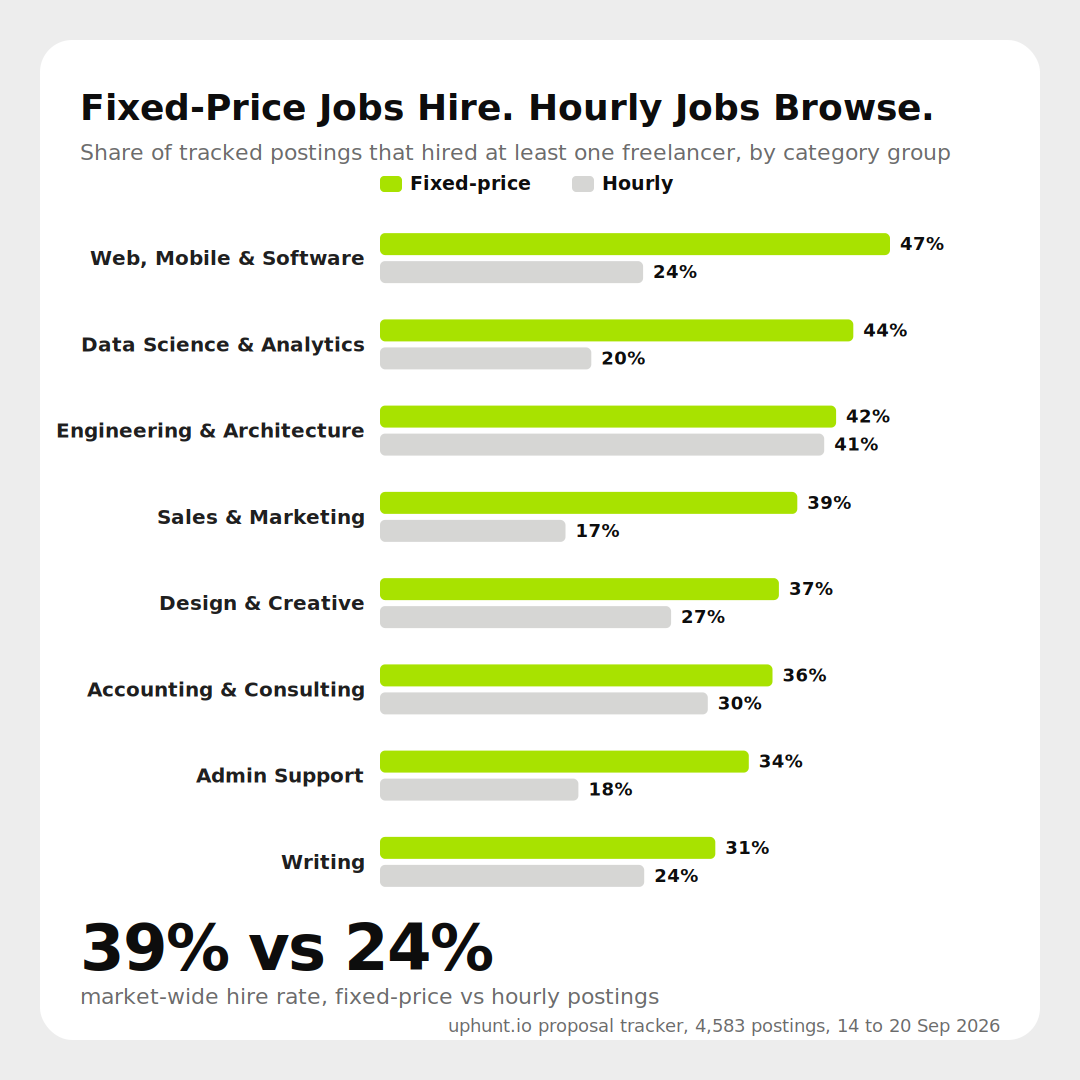
We tracked 4,583 postings minute by minute for a week. Fixed-price jobs hired 39% of the time. Hourly jobs hired 24% of the time.
The short answer
- Fixed-price postings hire 39% of the time; hourly postings hire 24%. A fixed-price job is about 1.7x as likely to end with someone hired.
- Per proposal, fixed-price is about 2.6x better. One hire per roughly 33 proposals on fixed-price, versus one per roughly 85 on hourly.
- Hourly jobs are more crowded. The median hourly posting draws 13 proposals; the median fixed-price posting draws 9.
- The advantage holds in every category group we could pair, with one near-tie in Engineering.
- Hourly still wins for long relationships. The hire-rate gap is about the job being real, not about hourly work being worse.
Fixed-price vs hourly on Upwork: the market numbers
Of the 4,583 postings the tracker followed between 14 and 20 September 2026, 2,451 were fixed-price and 2,132 were hourly. Here is how they compare.
| Metric | Fixed-price | Hourly |
|---|---|---|
| Postings tracked | 2,451 | 2,132 |
| Hire rate (at least one hire) | 39.4% | 23.8% |
| Wins per proposal | 3.03% | 1.18% |
| Proposals per hire | ~33 | ~85 |
| Median applicants | 9 | 13 |
| Mean applicants | 14.3 | 21.6 |
Two things stack here. Fixed-price jobs fill more often, and each one has fewer people bidding on it. That is why the wins-per-proposal gap (2.6x) is wider than the hire-rate gap (1.7x).
On advertised pay, the median fixed-price budget in the sample was $100. The median advertised hourly rate, taken as the midpoint of the posted range, was $20 per hour. These are what clients wrote, not what anyone was paid, and they live in seperate distributions, so do not convert one into the other.
Should I bid on hourly or fixed-price? Hire rate by category
The market-wide gap could hide a mix effect, with hourly jobs simply clustering in weaker categories. It does not. Every group with at least 40 postings on each side shows fixed-price ahead.
| Category group | Fixed hire rate | Hourly hire rate | Fixed median applicants | Hourly median applicants |
|---|---|---|---|---|
| Web, Mobile & Software Dev | 47.3% | 24.4% | 17 | 26 |
| Data Science & Analytics | 43.9% | 19.6% | 13 | 22 |
| Engineering & Architecture | 42.3% | 41.2% | 7 | 14 |
| Sales & Marketing | 38.7% | 17.2% | 7 | 10 |
| Design & Creative | 37.0% | 27.0% | 8 | 12 |
| Accounting & Consulting | 36.4% | 30.4% | 10 | 11 |
| Admin Support | 34.2% | 18.4% | 6 | 14 |
| Writing | 31.1% | 24.5% | 6 | 13 |
Among the widest gaps are Sales & Marketing, Admin Support and Data Science, where an hourly posting is roughly half as likely to hire as a fixed-price one. Software Dev is the most striking case: fixed-price postings there hire nearly half the time, hourly postings less than a quarter, and hourly draws the biggest crowds in the sample.
Engineering & Architecture is the one group where the two are close on hire rate, though hourly postings there still draw twice as many applicants at the median.
The arrival curve: hourly jobs get crowded faster
Because the tracker polls every minute in the first hour, we can see how fast the pile grows.
- First-hour share. Fixed-price postings receive 63% of their tracked proposals in the first hour. Hourly postings receive 57%.
- Time to five proposals. The median hourly job has 5 proposals within 18 minutes. The median fixed-price job takes 22 minutes.
- After one hour, the median hourly job has 8 proposals; the median fixed-price job has 6.
- After twelve hours, the median hourly job has 15 proposals; the median fixed-price job has 10.
Hourly crowds arrive faster and keep coming; fixed-price fields are thinner and settle earlier. Either way, the first hour is when your proposal is still near the top of the stack, as we cover in the best time to apply on Upwork.
What this means for your Connects
The fixed-price advantage is not about you. It is about the client.
A hire rate is the share of postings where anyone at all was hired. When 76% of hourly postings never hire, that is not 76% of freelancers losing to a better proposal. It is the client not hiring anyone. You could write the perfect proposal and still recieve nothing, because the job was never going to close.
A fixed-price posting comes with a number the client had to commit to before publishing, and that commitment filters out a lot of window shopping. An hourly posting can go live with a vague range and no plan, and the data says that happens more often.
Market-wide, about 40% of Upwork postings ever hire anyone. Fixed-price sits above that average, hourly below it. Connects cost the same either way, and Upwork's fees take the same cut of whatever you earn, so the expected return on a Connect is simply higher on fixed-price postings.
When hourly jobs still win
None of this means you should stop bidding on hourly work.
Hourly contracts are where long relationships live. A fixed-price job ends when the milestone is paid; an hourly contract can run for months, and one can outweigh a dozen small fixed-price wins. The tracker only sees whether a posting hired, not what the contract went on to earn. Hourly also carries payment protection for tracked time. And in Engineering & Architecture the gap is small enough that the job itself should decide.
If you specialize in ongoing work, the part-time hourly market on Upwork has its own patterns worth knowing. This post's claim is narrower: when Connects are limited, the fixed-price posting is more likely to be a real job.
How we measured this
The numbers come from UpHunt's proposal tracker. Upwork shows applicants a bucket, but its public job details carry an exact count. The tracker reads that count every minute for the first hour after a job goes live, then hourly, then daily, and records whether the posting ever shows a hire. It has been running since 14 September 2026.
This post uses the first seven days, 14 to 20 September 2026, 4,583 postings. A few limits to keep in mind.
- Seven days is a short window. Category-group figures are solid at this size; finer occupation splits are not, so we stopped at the group level.
- Visitor-visible postings only. The tracker polls as a logged-out visitor, so postings that require a login never yield a count. Those skew towards higher-budget work, so the sample under-represents the expensive end.
- Pay is advertised, not realized. The fixed-price budget and the hourly rate are what the client typed into the posting, not what was paid.
- Hire rate counts postings, not freelancers. It is the share of postings where at least one person was hired. Wins per proposal is total hires divided by total proposals across all tracked postings, including those that never hired, so it needs no correction.
More from the same dataset is on our Upwork jobs data page.
See whether a job is real before you spend Connects
Averages do not tell you whether this job is real. The UpHunt feed does: every job shows its live proposal count where Upwork publishes one, updated minute by minute in the first hour, plus a client score, so you can see how crowded a job is and whether the client looks like one who hires. An AI score from 1 to 10 with a plain-language reason tells you whether it fits you. Start a free 7-day trial of UpHunt Basic and stop paying Connects for postings that were never going to close.