

The Best Time to Apply on Upwork, According to 3.25 Million Job Posts
Ask ten freelancers when to send Upwork proposals and you will get ten confident answers, none of them backed by data. So we checked. We took every public Upwork job posted between January 2025 and June 2026, all 3,253,248 of them, and looked at exactly when clients hit publish.
This is, as far as we know, the largest study of Upwork posting times ever published. The biggest one we could find elsewhere used 142,000 jobs. This one is 22 times larger, and some of what it shows contradicts the usual advice.
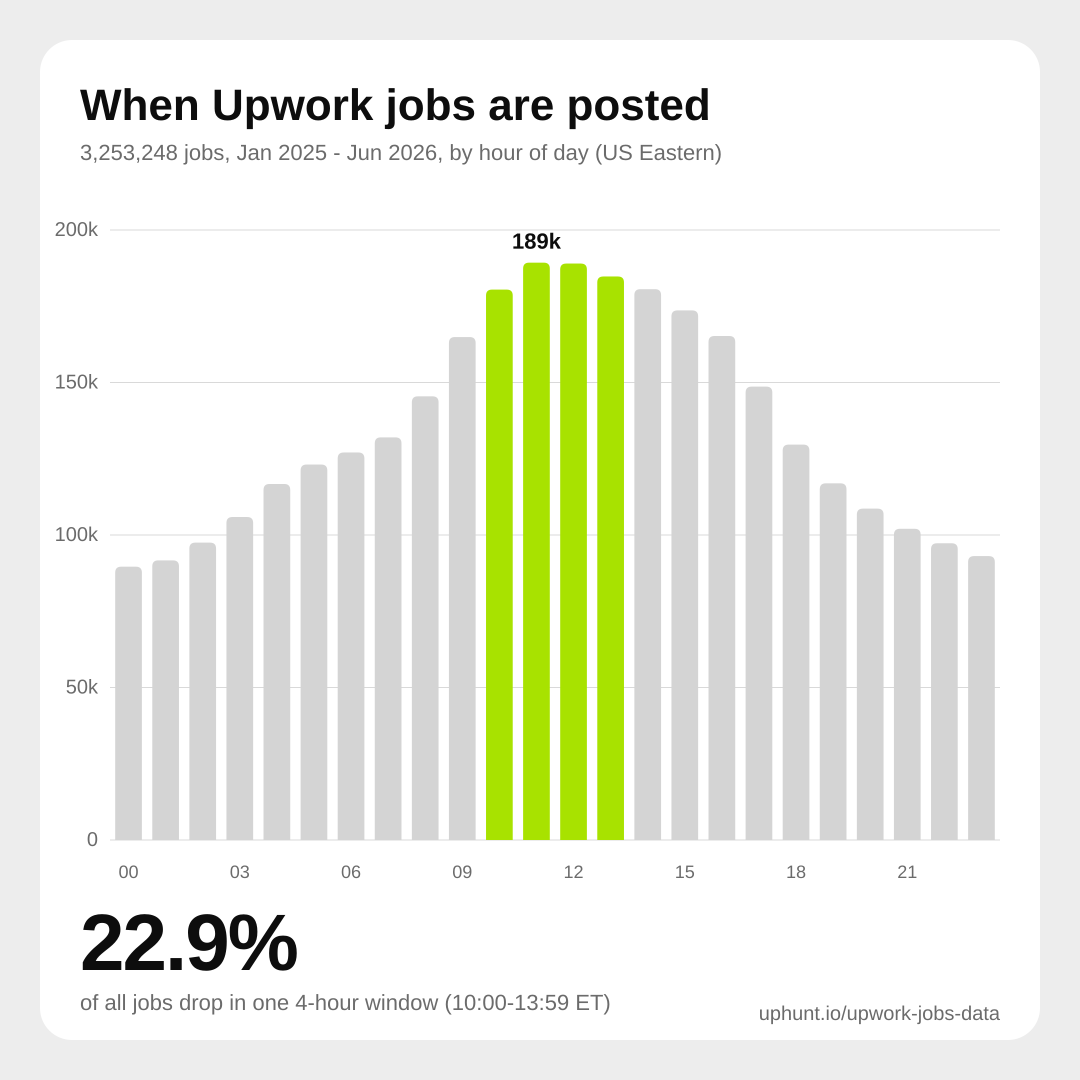
The headline: one 4-hour window carries 22.9% of all jobs
Upwork's posting clock has a clear shape. Job volume climbs through the US morning, peaks at 11:00 US Eastern with 189,293 jobs across our window, holds a high plateau through early afternoon, then slides all evening to a midnight floor of 89,615.
The numbers that matter:
- Peak hour: 11:00 ET. The quietest hour is midnight ET, and the gap between them is 2.1x.
- 10:00 to 13:59 ET is the flood. That single 4-hour window carries 743,506 jobs, or 22.9% of everything posted, in just 17% of the day.
- The classic 9-to-5 ET workday carries 43.9% of all jobs in a third of the day.
- At the 11:00 ET peak, jobs arrive at roughly 5.8 new posts per minute.
If you only remember one thing: the middle of the US business day is when the pie gets refilled. Everything else is a slower trickle.
Tuesday is the busiest day, and the weekend really is dead
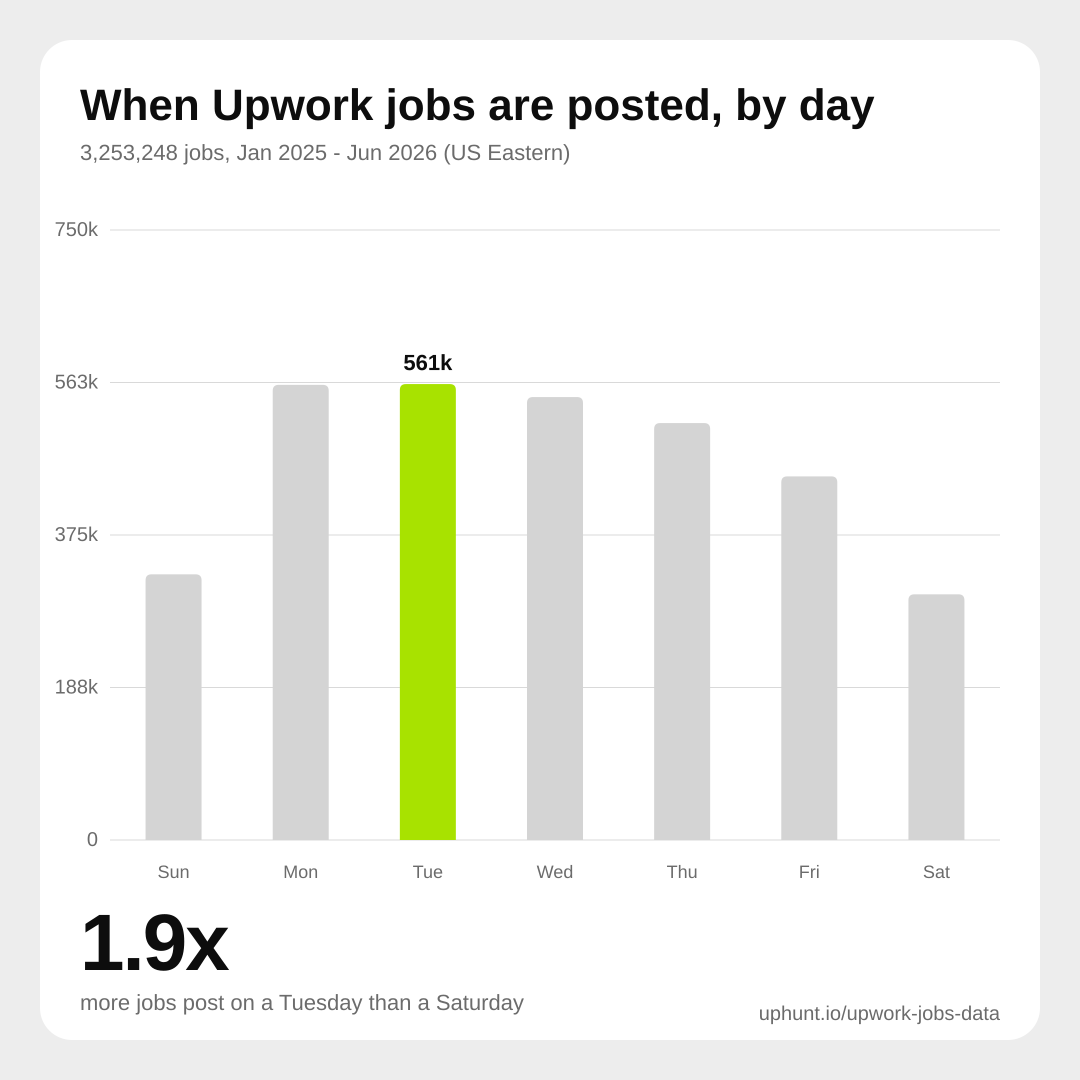
Tuesday edges out Monday as the busiest posting day (560,553 vs 559,630 jobs), with volume decaying through the week. Saturday is the floor at 302,091. A Tuesday produces 1.9x the jobs of a Saturday, and the weekend as a whole contributes just 19.3% of weekly volume.
So the folklore about "post-weekend backlog Mondays" is half right. Clients do return in force after the weekend, but the effect peaks on Tuesday, not Monday morning.
The money hours are not the busy hours
Here is the part the usual advice misses. We tagged every job as high-budget or not (fixed-price at $1,000 or more, or an hourly ceiling of $80/hr or more) and tracked that share across the day.
The high-budget share of postings is not flat. It bottoms out around 7.2% in the early US morning and climbs all afternoon to peak at 8.5% between 17:00 and 18:00 ET. In absolute terms the noon hour still produces the most high-budget jobs (15,502 in our window, simply because volume is huge then), but the density of well-funded work is best at the end of the US workday.
Why? The client mix changes hour by hour. At 05:00 ET only 12.0% of new jobs come from US clients. By 17:00 ET it is 43.3%. Late afternoon Eastern is when American clients, who fund a disproportionate share of the four-figure contracts, dominate the feed.
Now convert 17:00 ET to the places most freelancers actually live. It is 22:00 in London, 23:00 in central Europe, 02:30 in India, and 05:00 in Manila. The richest slice of the Upwork day lands when most of the world's freelance workforce is asleep. That is not a small edge for whoever is awake, or whoever has something watching the feed for them.
Does posting time even matter if you apply late?
Honestly, less than you would hope. Posting-hour strategy is about being early relative to the job, not about picking a lucky hour to sit down and send proposals. A job posted at 11:00 ET that you find at 19:00 ET is already an old job with a stacked proposal list, whatever hour you personally prefer to work.
That is the real lesson of the 5.8-jobs-a-minute peak: no human refreshes their way through that. The freelancers who consistently land in the first few proposals either live inside the 10:00 to 14:00 ET window, or they get notified the moment a matching job goes live and dont depend on being at the keyboard at all.
Speed also compounds with everything else you do. Our earlier look at boosted proposals found that boosting cannot rescue a late proposal, and being early costs nothing but timing. If you are budgeting Connects, early beats boosted.
Practical playbook by timezone
- US Eastern freelancers: you are living on the peak. Check the feed 10:00 to 14:00, and once more around 17:00 when the high-budget share tops out.
- Europe: the flood starts mid-afternoon your time (15:00 to 19:00 London for the 10:00 to 14:00 ET window). The money hours land at 22:00 to 23:00, which is exactly when job alerts earn their keep.
- South and Southeast Asia: the entire prime window is your night. Competing manually means fighting your own sleep schedule; this is the timezone where automation stops being a luxury.
- Everyone: Saturday night into early Sunday morning US time is the quietest stretch with the fewest new posts. Its a fine time to write profile copy and templates, and a poor time to hunt.
Method notes
Dataset: 3,253,248 public Upwork job posts published between 1 January 2025 and 30 June 2026, collected by UpHunt's live scraper (the same one that powers our Upwork jobs dataset). Timestamps are Upwork's own publish times, converted to US Eastern with daylight saving handled. High-budget means a fixed price of $1,000+ or an hourly budget ceiling of $80/hr+. Client country comes from the public buyer profile on each job.
We publish alot of what our dataset shows, including which stacks are growing and dying and which AI model clients ask for by name. If there is a slice you want to see, tell us.
The takeaway
There is a best time to apply on Upwork, and now you have the actual clock: 10:00 to 14:00 US Eastern for volume, late afternoon Eastern for budget density, Tuesday for the busiest feed. But the deeper truth in 3.25 million timestamps is that the clock rewards presence, not preference. The jobs drop when American clients are at their desks. The freelancers who win them are the ones who show up within minutes, whether in person or with a bot standing watch.
UpHunt watches the feed every minute of every hour, scores each new job against your profile, and alerts you (or applies for you) while the job is still fresh. If your timezone fights the Upwork clock, that is exactly the problem it was built for.