

Finding First-Time Upwork Clients Before Anyone Else Applies
Most Upwork advice tells you to avoid clients with no hiring history. The logic sounds safe: no reviews, no track record, might not know how the platform works. But that advice quietly writes off more than a third of the entire market, and it hands the best-kept opening on Upwork to the freelancers willing to move fast.
We checked the hiring history behind real job postings, and first-time clients are not a rounding error. They are the single largest group of buyers on the platform.
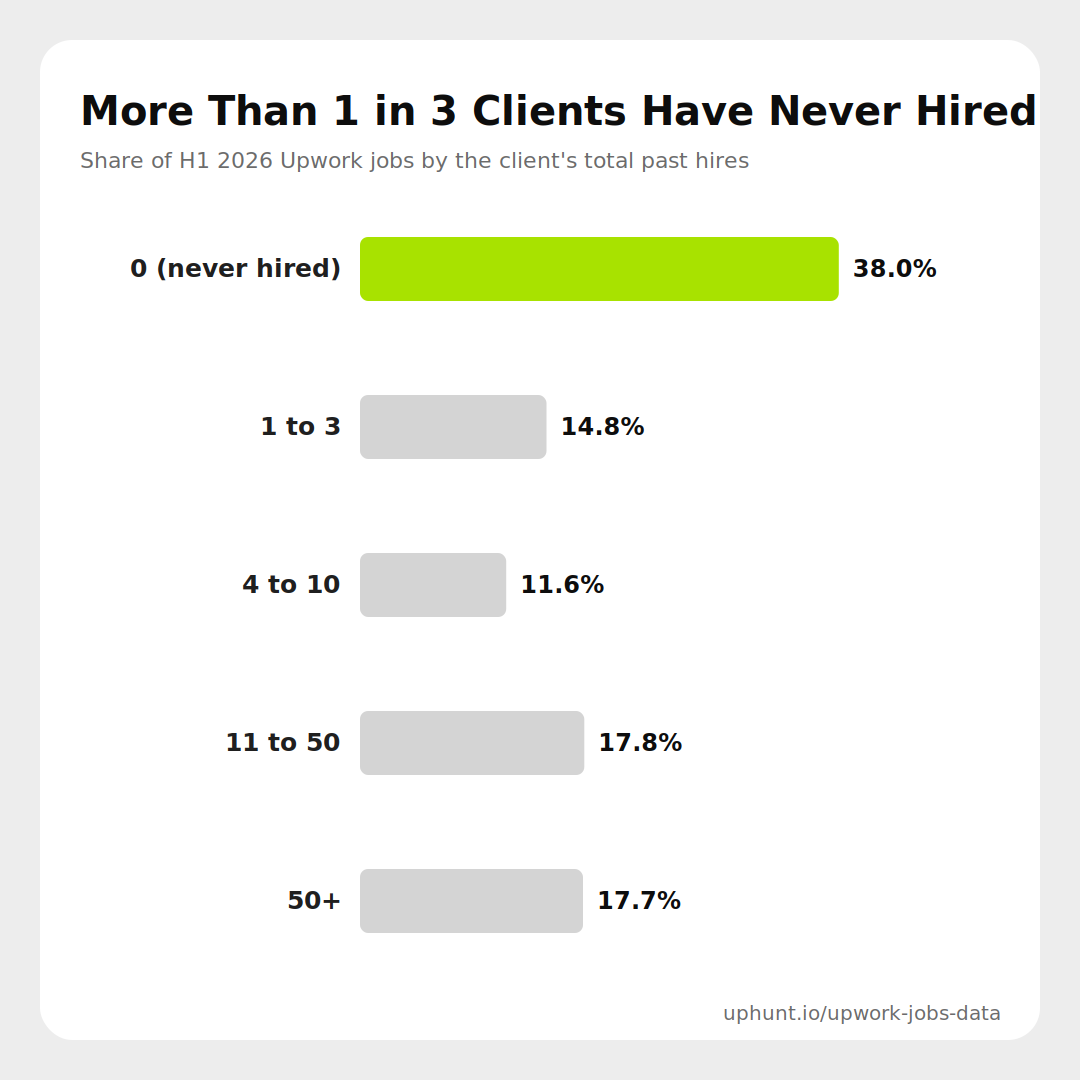
38% of Upwork Jobs Come From First-Time Clients
We looked at 214,721 Upwork job postings from H1 2026 where we could resolve the client's complete hiring record. Then we sorted every posting by how many freelancers that client had ever hired before.
| Client's total past hires | Share of jobs |
|---|---|
| 0 (never hired anyone) | 38.0% |
| 1 to 3 | 14.8% |
| 4 to 10 | 11.6% |
| 11 to 50 | 17.8% |
| 50+ | 17.7% |
38.0% of postings came from a client who had never hired a single freelancer before. Add the clients who had hired just once, and 45.4% of the market has effectively no hiring track record. More than half (52.9%) had hired three times or fewer. The seasoned, hire-fifty-people clients everyone chases? They post fewer than one in five jobs.
Why First-Time Clients Are an Opening, Not a Risk
The standard warning treats "no hires" as a red flag. Sometimes it is. But two things make first-time clients one of the most winnable segments on Upwork, and both work in a fast freelancer's favor.
There is no incumbent. When a client has hired ten people, they usually have a favorite they re-invite, or a shortlist of freelancers they already trust. A first-time client has none of that. The playing field is genuinely flat, and your proposal is competing on its merits instead of against someone's three-year relationship.
They decide fast, because they do not know they are supposed to wait. Experienced clients let a job marinate for a day and sift fifty proposals. A first-time client posts a job, gets a handful of early replies, talks to one or two that look competent, and hires. If you are not in that first handful, you were never really in the running. This is the same dynamic we found in our timing analysis: early proposals win, and with inexperienced clients the window is even shorter.
That does not mean every first-timer is a dream client. Some have not verified a payment method, some have unrealistic budgets, and a genuinely bad brief is still a bad brief. Screen them the way you would screen anyone, using the red flags that show up before you bid. The point is not to bid blind. It is to stop auto-rejecting the largest and most winnable third of the market.
How to Actually Find Them First
Knowing 38% of jobs are first-time clients is useless if you see those jobs six hours late, after the client has already talked to two people. Finding them first comes down to two moves.
Filter for them on purpose. Upwork lets you filter search by client history, including clients with no hires yet. That surfaces the segment, but it does not solve timing, because you are still refreshing a search page and competing with everyone else refreshing the same page.
Get alerted the moment one posts. The real edge is being in that first handful of proposals. That is the entire reason instant job alerts exist: the second a matching job goes live, you know, instead of finding it on your next scroll. For a first-time client who is going to hire from early replies, showing up in the first thirty minutes is worth more than a perfect proposal that lands on hour six.
For new freelancers especially, this is the cleanest path onto the platform. First-time clients are less fixated on your Job Success Score and review count because they have no basis for comparison yet, which is one of teh few real advantages a beginner has. If you are just starting, pair this with our guide to landing your first Upwork client. And if you have been wondering whether the platform has simply gotten harder, our data on whether Upwork is getting harder for beginners puts this segment in context.
The Method
We analyzed 214,721 Upwork job postings from H1 2026 (January to June) for which we could resolve the client's full hiring history from Upwork's own client stats (totalJobsWithHires, populated on more than 99% of the enriched records). We grouped each posting by the client's lifetime hire count and computed each group's share of the total. "First-time client" means a lifetime hire count of exactly zero at the time the job was posted. Numbers are counts of real postings, not survey estimates.
The Bottom Line
The advice to skip clients with no history is costing freelancers the biggest, flattest, fastest-moving segment on Upwork. First-time clients are 38% of the market, they have no incumbent to beat, and they hire from the first few proposals they read. The whole game is being one of those proposals.
UpHunt is built for exactly that: real-time alerts the instant a matching job posts, AI scoring so you can tell a real first-time client from a time-waster before you spend a Connect, and managed applying so you land in the first handful without living inside the Upwork search page. You cannot out-review a client's favorite freelancer on a job they have posted for the tenth time. You can be first on the job they have posted for the first.