

How Fast Does Competition Arrive on Upwork? Minutes to 5 Proposals, by Category (2026)
We already know when clients post Upwork jobs and how many of those postings ever hire anyone. The question this post answers is different: once a job goes live, how long do you actually have before the proposal list fills up? We tracked live postings minute by minute to find out, and the answer depends enormously on what category you work in.
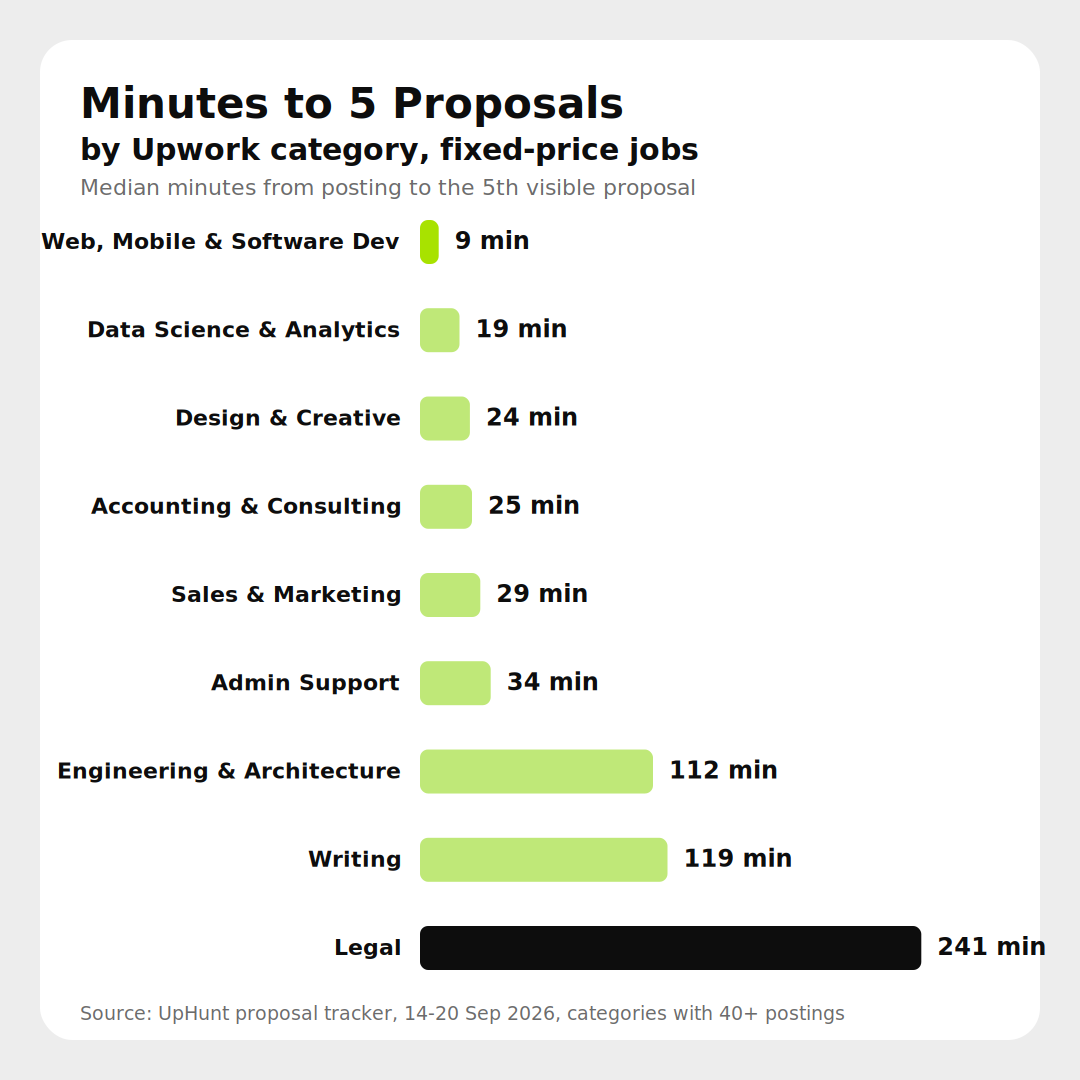
In Web, Mobile & Software Dev, a fixed-price job reaches 5 proposals in a median of 9 minutes. In Legal, the same milestone takes a median of 241 minutes, just over 4 hours. That is a 26.8x gap between the fastest and slowest category we could measure reliably.
The method
Our proposal tracker polls the public proposal count on live Upwork job postings at fixed intervals, from the moment a posting appears through its first 24 hours, and we join that to each posting's advertised pay type (hourly or fixed) and category from the job feed. This post uses 6 days of tracker data, 14 to 20 September 2026, read at the category grain, which is the only grain with enough postings per category to trust a median. We kept category rows with 40 or more tracked postings; thinner occupation and skill cuts exist in the underlying data but are not reliable enough to publish numbers from yet.
One real limitation: the tracker reads the proposal count from a page that only loads for visitor sessions. Postings that require a login to view never yield a count, about 98% of the curves we loose, and those tend to skew toward higher-budget, more guarded jobs. So these numbers describe the public, visitor-visible market, which is most of Upwork, but not quite all of it.
Market-wide, fixed-price jobs fill slower but more thoroughly than hourly
Across the whole tracked market, hourly jobs reach 5 proposals in a median of 18 minutes, slightly faster than fixed-price at 22 minutes. But fixed-price jobs front-load harder once they get going: 62.8% of their eventual proposals arrive in the first hour, against 56.6% for hourly. Both numbers say the same thing in different ways: most of your competition on an Upwork posting shows up before you have finished reading the brief twice.
Some categories are a sprint. Others are a slow burn
The market average hides a wide spread once you split by category. Looking at fixed-price postings with enough tracked volume to trust (40+ postings each):
- Web, Mobile & Software Dev: 9 minutes to 5 proposals (n=488). Median applicants in the first hour: 13.
- Data Science & Analytics: 19 minutes (n=57).
- Design & Creative: 24 minutes (n=798), the largest category we tracked.
- Accounting & Consulting: 25 minutes (n=99).
- Sales & Marketing: 29 minutes (n=445).
- Admin Support: 34 minutes (n=190).
- Engineering & Architecture: 112 minutes (n=156).
- Writing: 119 minutes (n=90).
- Legal: 241 minutes (n=41), the slowest category we could measure.
The pattern holds, with different numbers, on hourly jobs. Web, Mobile & Software Dev is again the fastest at 7 minutes to 5 proposals, with a striking median of 19 applicants inside the first hour. Writing is the slowest hourly category at 57 minutes, and Accounting & Consulting follows close behind at 45 minutes.
Development work is simply a faster market on both sides of the pay-type split. If you post development jobs, expect a crowded proposal list within minutes. If you apply to development jobs, the client will likely already have several proposals by the time you see the posting in a normal feed refresh, so being fast is not optional, it is the baseline. Writing, Legal, and Engineering & Architecture give you far more room, a proposal sent an hour or two after posting is still arriving while the client's inbox is thin.
What this means for where you spend Connects
Speed to apply matters most exactly where this data says it matters most: the fast-filling categories. In Web, Mobile & Software Dev, a proposal sent inside the first 9 minutes is one of the first 5 in the queue. Wait an hour and the median posting already has 13 competitors in it. Market-wide, it takes about 11 proposals for one hire, swinging from 8 to 22 depending on the category, so starting from position 13 instead of position 5 is not a small difference.
In the slow-burn categories, the opposite strategy works. There is less value in refreshing Upwork every ten minutes for a Legal or Writing posting, because the field barely fills in the first hour regardless. Your Connects are better spent writing a stronger proposal then racing the clock.
This also reframes the hourly-vs-fixed hiring data we published last month: fixed-price jobs hire more often, but in the categories where they also fill fast, that advantage only reaches freelancers who see the posting early. A high hire rate on a job you apply to after the first hour, in a category that fills in under 10 minutes, is not the hire rate you are actually getting.
The UpHunt feed exists for exactly this gap. It surfaces every public Upwork job the moment it is posted, with an AI score and a plain-language reason for your profile specifically, so you are not relying on checking Upwork manually during the one window that decides whether your proposal lands near the top of a fast-filling category or well down the list. You can see more of the underlying dataset on our Upwork jobs data page, or start a free 7-day trial of UpHunt Basic and see how fast jobs in your category typically fill before deciding how to spend your next Connect.