

Which Upwork Client Countries Actually Have Money? 2026 Data
Every Upwork freelancer has a rough mental map of where the good clients come from. Usually it is just "the US," maybe with "and the UK" tacked on. We pulled 388,839 real job postings from June through August 2026 and checked that assumption against actual client spend data. The map holds up in places and breaks in others, and the gap between where the volume is and where the money is turns out to be the more useful thing to know.
The method
For every job posting in the window, we looked at the client's declared country and their lifetime Upwork spend at the moment we saw the post (Upwork tracks and surfaces this on every client profile). We are not measuring how much a country's clients spend in total, we are measuring what share of job POSTS from that country come from a client who has already proven they spend real money on the platform, meaning $10,000 or more in lifetime charges. A country can post a lot of jobs and still have a low share of proven spenders, if most of its postings come from clients trying Upwork for the first time.
One data-quality note in the interest of full honesty: Upwork's own country field is not consistently formatted in the raw data we scrape, sometimes returning "United States" and sometimes "USA" for what is functionally the same country. We merged known variants (US/USA, UK/GBR, and similar) before counting so the same country was not accidentally split into two rows.
Volume leader: the United States, by a wide margin
The United States posted 40.2% of every job in our three-month window, more than the next nine countries combined. The United Kingdom is a distant second at 6.2%, followed by India (5.0%), Australia (4.7%), and Canada (3.7%). If you are optimizing purely for job volume, this is not new information, the US has been the center of gravity on Upwork for years and nothing in this data suggests that is changing.
Quality leader: not the United States
Volume and spend quality are different axes, and they do not line up the way most freelancers assume. We looked at what share of each country's job posts came from a client with $10,000 or more in lifetime Upwork spend, restricted to countries with enough postings in the window to be a reliable read (2,000+ posts).
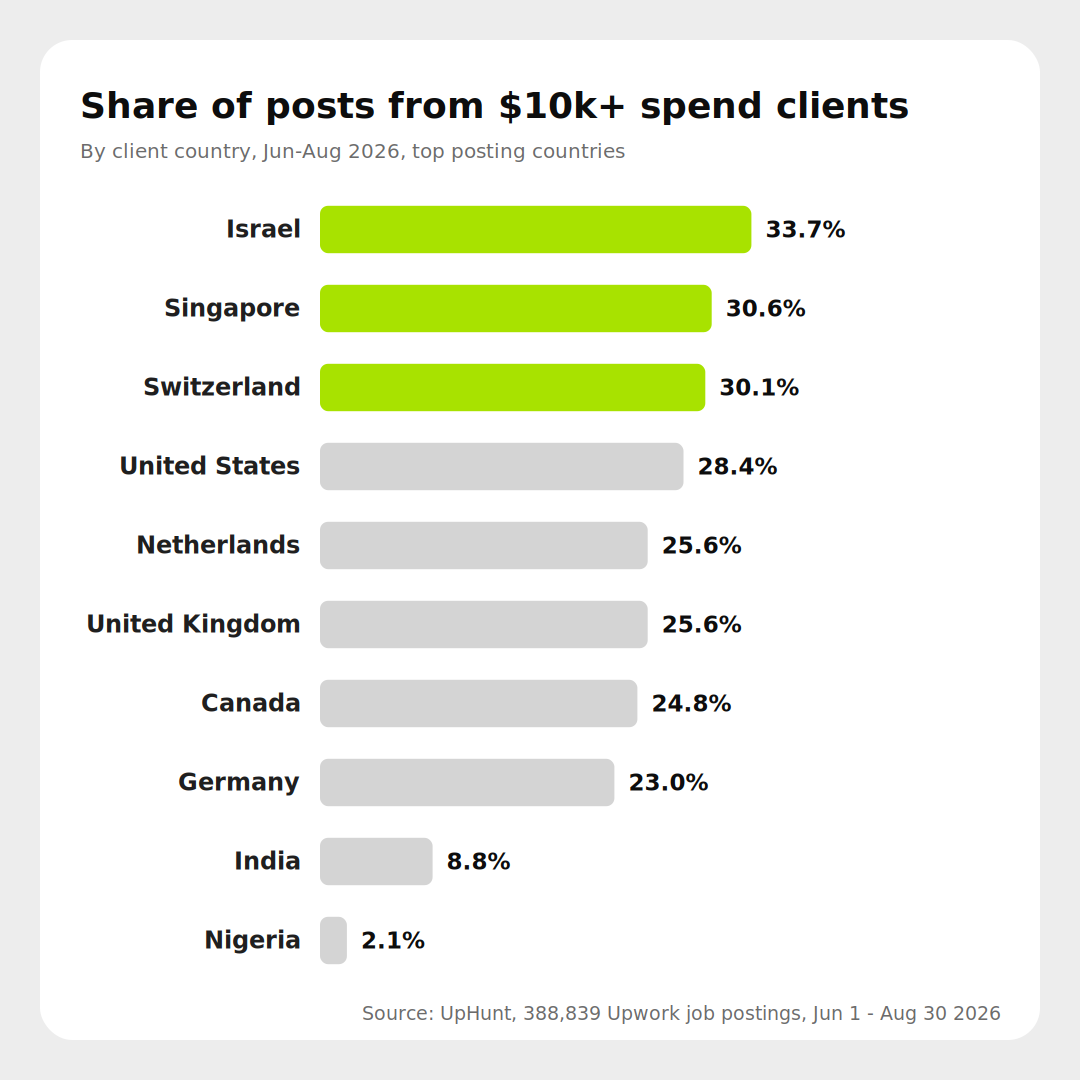
Israel leads at 33.7%, followed by Singapore (30.6%) and Switzerland (30.1%). The United States, despite dominating on raw volume, sits fourth at 28.4%. The Netherlands and United Kingdom are essentially tied at 25.6%, and Canada (24.8%) and Germany (23.0%) round out the upper tier.
The bottom of the range tells a different, and honestly more useful, story: India sits at 8.8% and Nigeria at 2.1%. That does not mean there is no money in those markets, both countries post tens of thousands of jobs and some of those clients are well-funded. It means a much smaller share of any single posting from those countries is likely to come from a proven high-spend buyer, so the odds shift more toward newer or lower-budget clients on any given job.
What "$10k+ lifetime spend" is actually filtering for
A client who has spent $10,000 or more on Upwork has, by definition, already done this before. They have hired, paid, and (usually) come back. That does not guarantee any single job post from them is well-scoped or well-paid, but it does mean you are dealing with someone who understands how the platform works, has a track record you can check, and is less likely to disappear mid-contract. Our Upwork trust signals breakdown covers the other verification signals worth checking, phone verification, screening questions, and Upwork's own Top Client badge, alongside this one.
The flip side matters too. A large share of postings in every single country we measured, even the highest-scoring ones, come from clients without that $10k+ history. Even in Israel, the top country, two out of three postings are still from a client below that threshold. First-time and lower-spend clients post good jobs constantly, and treating "no spend history" as an automatic red flag would filter out a lot of real opportunity, a point we go into in more depth in our first-time clients data breakdown.
What this means for where you spend your Connects
If you are choosing between two similar jobs and one is from a country with a structurally higher share of proven spenders, that is a legitimate, data-backed tiebreaker, not a stereotype. It is a weak signal on its own and a genuinely useful one when combined with the client's individual profile: their actual spend history, hire rate, and feedback score, which you can check before you bid.
The more practical takeaway is not "avoid certain countries." It is that volume and quality are two separate things to track, and chasing the country with the most postings is not the same strategy as chasing the country with the best odds per posting. If your niche skews toward specific geographies (English-speaking markets, EU clients for GDPR-sensitive work, and so on) this data at least tells you which of those geographies are statistically stacked with more proven buyers before you specialize toward them.
None of this replaces reading the individual job post. A first-time client in a lower-scoring country can still be a great, well-paying, long-term relationship, and a proven $50k-lifetime client in a top-scoring country can still ghost you mid-contract. What this data gives you is where to lean the odds, not a rule to bid by.
Cover more ground without doing this math by hand
Checking a client's spend history, country, and every other trust signal on every single job post does not scale manually, especially if you are applying across multiple high-paying niches or geographies at once. UpHunt watches the Upwork feed in real time, scores every new job 1-10 with a plain-language reason, and sends the fit ones straight to Slack or Telegram the moment they post, so you are spending Connects on the postings worth your time instead of scrolling the full feed yourself. Try UpHunt free for 7 days and see the scored feed for youself.