

Did AI Kill Upwork Writing Jobs? What 3,253,248 Job Posts Show
Every few months another headline declares freelance writing dead, usually backed by a survey or a vibe. We have something better: every public Upwork job posted between January 2025 and June 2026, all 3,253,248 of them, including 104,774 jobs in Upwork's four writing categories. So we counted.
The short answer: yes, AI gutted Upwork writing demand, and faster than almost anyone has reported. The longer answer is more interesting, because the collapse is not uniform, the one gold rush everyone predicted never showed up, and the money attached to the surviving jobs never cratered.
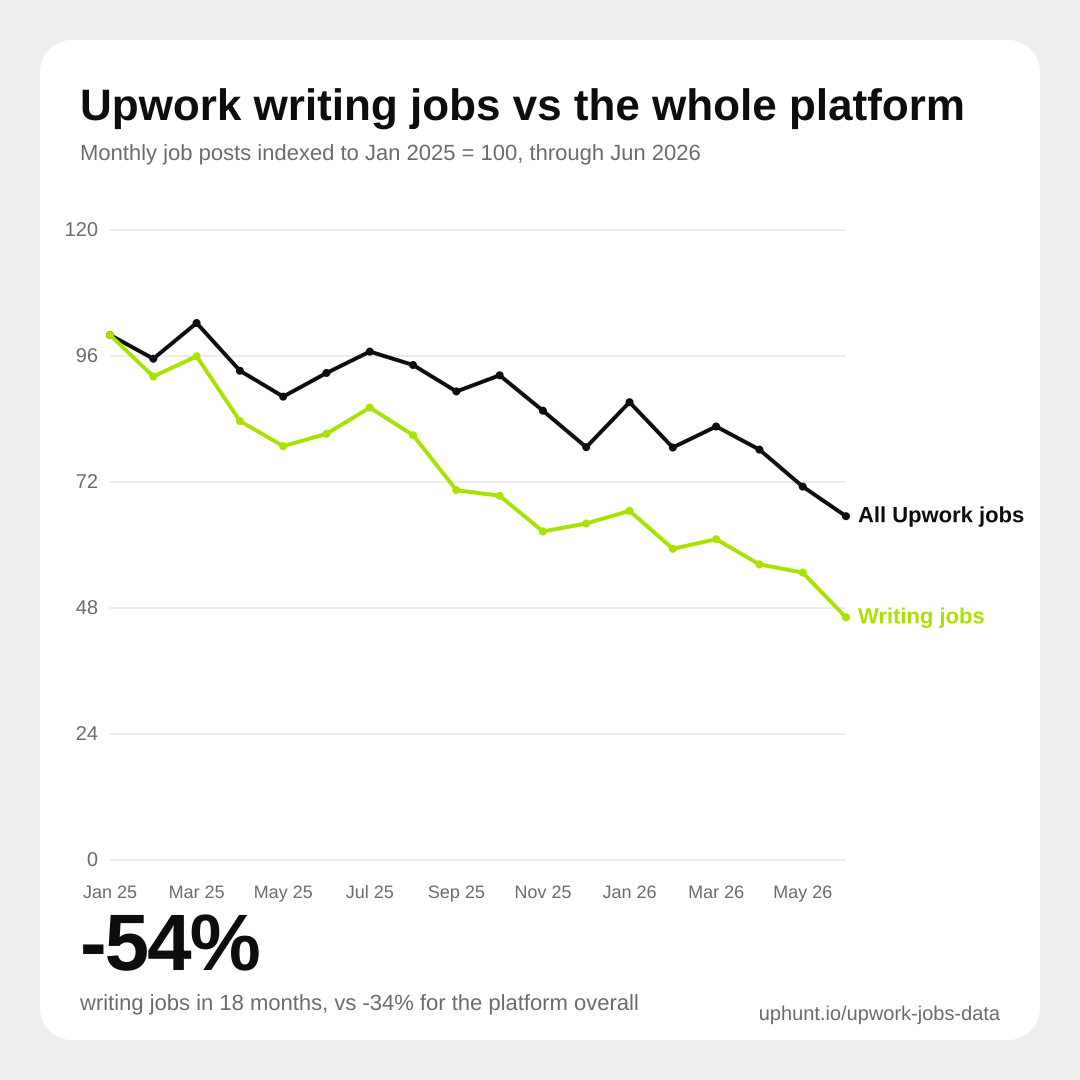
Upwork writing jobs fell 54% in 18 months, 1.6x faster than the platform
In January 2025, Upwork clients posted 8,002 writing jobs. In June 2026, they posted 3,698. That is a 53.8% collapse in 18 months.
Some of that is the platform itself shrinking. Total Upwork postings fell from 206,948 to 135,517 in the same window, a 34.5% drop. But writing fell roughly 1.6x faster than everything else, and its share of all posted work slid from 3.87% to 2.73%. This is not writers riding a platform-wide downturn. Writing is specifically losing ground.
The trajectory is also steepening. A widely cited Mediabistro analysis put the decline in freelance writing projects at 32% year over year. Our count says it is now worse: June 2025 to June 2026, writing postings went from 6,496 to 3,698, a 43.1% drop in a single year. Early academic work, like the Brookings analysis of freelance markets and the 2023 Washington University study, measured single-digit declines in the first months after ChatGPT launched. Our data picks up where those left off, and the answer to "was that just the short run?" turns out to be no. It compounded.
The work rotated from writing words to judging them
The headline number hides the real story. Break the writing cluster into Upwork's own subcategories and compare January 2025 to June 2026:
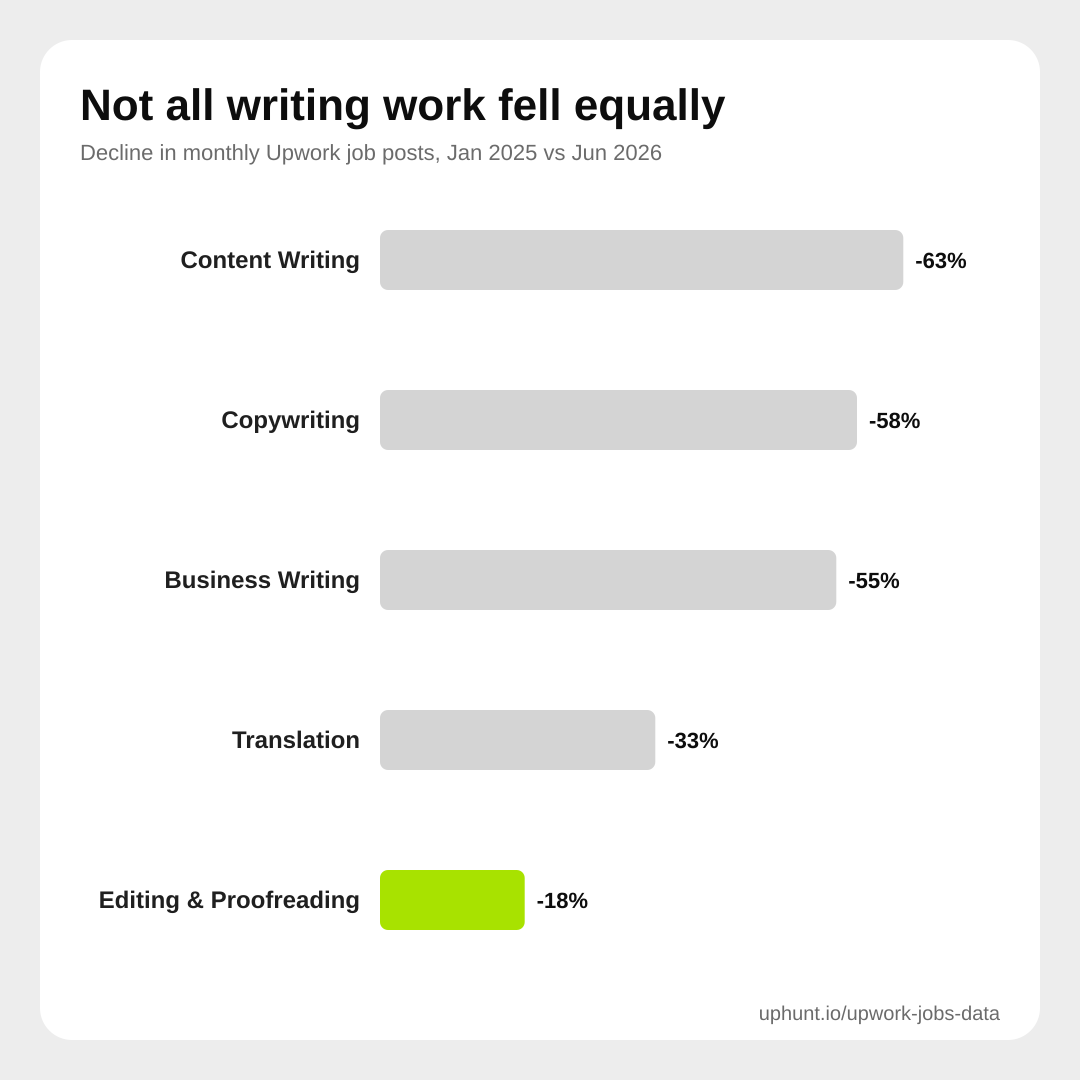
- Content Writing: 4,733 to 1,737 jobs, -63.3%. The commodity blog-post-and-article engine took the hardest hit on the platform.
- Sales & Marketing Copywriting: 784 to 332, -57.7%.
- Professional & Business Writing: 1,118 to 501, -55.2%.
- Translation & Localization: 2,454 to 1,636, -33.3%. Almost exactly the platform-wide rate, which suggests machine translation had already taken its bite before our window opened.
- Editing & Proofreading: 1,367 to 1,128, -17.5%. Half the platform's decline rate, and barely more than a quarter of content writing's.
That last line is the one that matters. The work clients still pay humans for is shifting from producing words to judging them. In January 2025, editing and proofreading was 17.1% of all writing demand on Upwork. By June 2026 it was 30.5%. Clients increasingly arrive with a draft, often a machine's draft, and pay a human for taste, accuracy, and accountability. Its the same rotation we found on the developer side, where debugging and code-review work outgrew greenfield builds: AI does the first pass, humans get hired for the second.
The "humanize AI content" gold rush never arrived
For two years, freelance gurus have pitched "humanizing AI content" as the escape hatch, the new job category that would absorb displaced writers. The data is brutal on this one.
Across all 3.25 million jobs, postings asking to humanize, de-robotify, or make AI text undetectable totaled 239 in the first half of 2025 and 184 in the first half of 2026. That is roughly 22 to 49 jobs per month, platform-wide, and the trend is down, not up. In every single month of our window, clients posted more than 100 ordinary writing jobs for every one "humanize this AI draft" job. Anyone selling you a course on becoming an AI humanization specialist is selling a market of about 30 jobs a month, shared with every other person who bought the course.
Freelance writing rates on Upwork did not crash, the job count did
Here is the twist we did not expect. If AI were commoditizing writing, you would expect the surviving jobs to get cheaper as clients anchor on "a robot could do most of this." That is not in the data.
The median fixed-price writing budget was $100 in January 2025 and $100 in June 2026, wobbling to $80 or $90 in only two of the 18 months. The median hourly midpoint sat at $25/hr in every single month. The distribution of pay did not deteriorate, the number of buyers did. The clients who left were the ones who used to pay for volume word production, and they now prompt instead. The clients who stayed still pay human-shaped rates for judgment-shaped work.
Fewer jobs at the same pay changes the game from pricing to positioning: the writers getting squeezed are not underbidding each other into the floor, they are competing for a feed that refills half as fast.
Method: how we counted
Dataset: 3,253,248 public Upwork job posts published between 1 January 2025 and 30 June 2026, collected by UpHunt's live scraper, the same pipeline behind our Upwork jobs dataset. Monthly buckets use Upwork's own publish timestamps. "Writing" is the sum of four Upwork categories: Content Writing, Editing & Proofreading Services, Professional & Business Writing, and Sales & Marketing Copywriting. Translation & Localization Services is tracked separately and not included in the writing total. "Humanize AI content" jobs are matched by title and description patterns (humanize/humanizing near AI-content terms). One caveat: the category field is null on a minority of jobs, about 13% in a June 2026 sample, so all category counts are lower bounds; the trend comparisons hold because the gap is present across the whole window. Budget medians use fixed-price amounts and the midpoint of hourly ranges as posted.
What this means for freelance writers in 2026
Three practical conclusions fall out of 104,774 writing jobs.
Move up the stack from producing to judging. Editing and proofreading are the resilient end of the market, down just 18% while pure content writing dropped 63%, and adjacent judgment work like fact-checking and rewriting rides the same shift. If your profile says "blog posts, fast turnaround," you are standing in the crater. If it says "I make drafts publishable," you are standing on the part that held. The same logic applies to specialization: generic volume writing is what AI replaced first, and the highest-paying niches are the ones where being wrong is expensive.
Do not chase the humanization mirage. Thirty-ish jobs a month is not a career path.
Be early on the jobs that remain. This is the uncomfortable arithmetic: the feed refills at half the old rate while the writer pool shrinks slower, so every posted job gets crowded faster. When demand was 8,000 jobs a month you could afford to browse; at 3,698 you cant. Speed compounds too, since proposals sent in the first minutes win disproportionately. That is exactly the problem UpHunt was built for: it watches the feed in real time, scores every new writing job against your profile, and alerts you the moment a match goes live, while the proposal count is still in single digits.
AI did kill a large piece of Upwork writing. It killed the piece where words were the product. The piece where judgment is the product is very much alive, better defended, and still paying what it paid before. The writers who survive 2026 will be the ones who moved there early and showed up to each job first.